
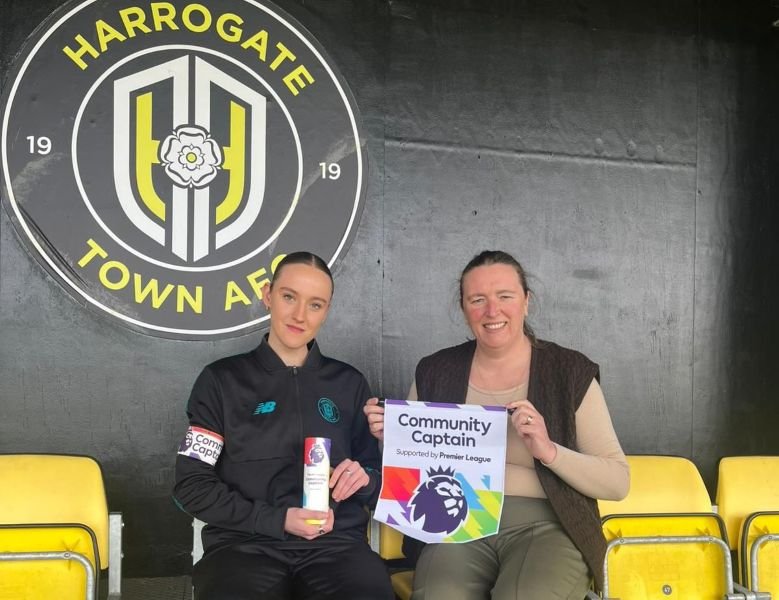
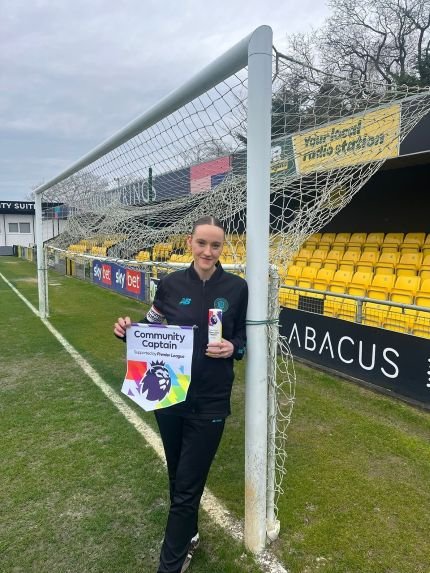
We caught up with Harrogate Town AFC’s Jess Leech, who has been named their Community Captain as part of the Premier League’s ‘More Than A Game’ campaign.
Jess was honoured with a special presentation award given to each participating club’s nominated Community Captain – someone who has shown exceptional leadership and values, and truly deserves recognition for their contributions to both the game and the community.
After being forced to turn down a place to play football at university due to a head injury, she secured a role as a Community Coach through the Job Centre, and now leads girls-only PL Kicks sessions. acting as both a coach and role model for young girls in her community, showing that there are routes into football beyond playing.
What were those early days like transitioning from player to mentor?
Transitioning from a player to a mentor felt like a huge shift initially. As a player, you’re so focused on your own performance, but with coaching Premier League Kicks sessions at Harrogate Town, I’ve had to take a step back and think about how different players learn and what they need from me to develop.
Going from just knowing the game and my own game to really understanding how to teach it, and helping others benefit from that knowledge, has probably been the biggest adjustment for me.
I’ve been really lucky to be able to coach every day since starting in my role, as well as being around some great coaches on Harrogate Town’s Premier League Foundation programmes. Observing how my colleagues work has helped me understand different approaches when working with different groups. It’s helped me a lot, and it’s something I still do now to keep improving. This journey has really developed my understanding of the game, which has actually helped me as a player as well!
You now lead girls-only sessions. What changes do you see in the girls who attend regularly, and what impact are you hoping to have on them?
One of the biggest changes I see in the girls I work with, aside from technical improvements, is their confidence and enjoyment of the game. A lot of them initially don’t see football as something for them, or something they would necessarily enjoy, but over time I’ve seen that completely change.
This is why girls-only sessions and the Premier League’s More Than a Game initiative is so important. The funding invested and the work being done creates an environment where the girls feel comfortable, included, and like they genuinely belong in the game. From there, you start to see the impact: their confidence and resilience grow. They become more willing to try, less afraid of making mistakes, and a lot more motivated to learn and improve. That development is something that always makes me really proud to see.
A special experience for me was getting the chance to work with a school group from Year 1 through to Year 2 who started with no experience at all, and by the end of my time with them some had joined local grassroots teams. Seeing that progression is massive, from having never really engaged with football to then being part of a team and playing regularly. We also organised an opportunity for them to be mascots at a women’s game. I think that was really important because it lets them see a clear pathway in the game and shows them that there is a place for them in football.
Ultimately, the impact I’m hoping to have is helping girls feel like football is for them, building their confidence, and giving them an experience they genuinely enjoy and want to keep coming back to.
What’s one moment from your coaching journey so far that made you feel, ‘Yes—this is why I’m doing this’?
A moment that stands out for me is when I was working with a player who came to me feeling quite deflated and expressed that they had been struggling with the themes and specific focuses of sessions over a few weeks. They also felt that the rest of the group were further ahead than them.
What really surprised me was that, from a coaching point of view, I hadn’t actually noticed any issue. Their performance on the pitch didn’t appear to drop, they were already a good player, and I could see improvement with the group, so nothing suggested they were behind. But speaking to them showed that internally they were feeling confused and lacked confidence in what they were doing.
We sat down and broke everything down together, and I gave them one simple, clear focus to take into the next session. When they came back, I reminded them of that focus, and after a few attempts it just clicked. From there, you could see the change, not necessarily in their ability as they were already playing like there was no issue, but in their understanding and confidence.
They came to me after a Premier League Kicks session and told me how proud they were. It really reinforced for me how important it is to understand what a player is actually feeling, not just what you see on the surface. Sometimes the biggest impact isn’t improving performance straight away, but building understanding and confidence that then brings everything else with it.
This moment made me feel really proud, not only because I was able to help them, but because they felt comfortable enough to come to me in the first place. It means a lot to me and made me proud of the environment I’m creating and the impact I can have on their development.
If you could give advice to another young person facing a career-changing injury or setback, what would it be?
If I could give advice to another young person going through a career-changing injury or setback, I’d say try not to let it define how you see yourself in the game.
From my own experience, injuries can have a huge impact. It can affect your confidence and how you see your place within a team, especially when you know others are continuing to develop while you’re stepping away. That can feel really difficult, especially when you are ready to return.
The key thing is focusing on what you can control during that period, whether that’s your recovery, your mindset, or finding other ways to stay involved and connected to the game. Your value within football can stay even when you are injured.
When you do come back, i think it’s vital to be patient with yourself. You’re not expected to be perfect straight away, and that’s okay. Giving yourself time to rebuild confidence and get used to the environment again is just as important as being physically fit.
Ultimately, I’d say try. Although the process can be a massive challenge, it’s important to not let a setback change how you see your ability or your future as a footballer.
The Premier League is removing barriers for women and girls through community programmes, grassroots football, the professional game and career pathways. FA support has helped 1,500 girls and young women take part in leadership training, while League-funded community programs involve over 100,000 women and girls each season. Co-funding for the Football Foundation has improved facilities used by more than 18,500 women’s and girls’ teams, and the PL is backing the FA Women’s National League strategy with £2.7m from 2025 to 2028.
More from the world of women’s football
Discover the latest issue of Her Goal Magazine, analysing Alexia Putellas' headline move to London City Lionesses and including a voucher to claim your FREE Women's Football Pyramid Poster 2026/27. Also featuring LCL's Isobel Goodwin, England’s Keira Barry in California, West Ham’s Nadine Riesen, Watford’s Anna Filbey and loads more from across the women's game.

Packed with exclusive interviews, player features, posters, quizzes and in-depth stories from across women’s football..
Also available from WHSmith, Morrisons, Asda, Waitrose, TG Jones and independent newsagents.