

Bayern Munich, Wolfsburg, Eintracht Frankfurt, Bayer Leverkusen – a glance at today’s top-flight women‘s teams in Germany reveals familiar names that mirror their male counterparts.
With the exception of SGS Essen, the only standalone women’s football club in the first division, most teams follow this pattern. But one name is still missing from the Frauen-Bundesliga: Borussia Dortmund.
A club steeped in tradition, forever nipping at Bayern’s heels on the men’s side, and yet, nowhere to be found at the top of the women’s game. The question is: why?
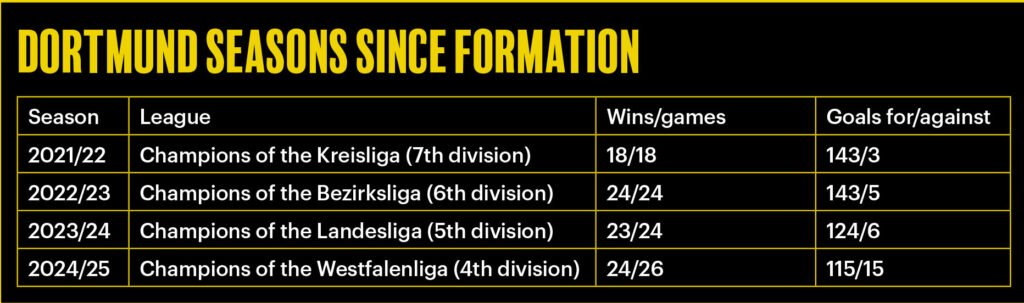
Currently, BVB’s first women’s team competes only in the Regionalliga West – the third tier. The department itself is still young; officially founded in the autumn of 2020. Since then, Borussia Dortmund has achieved an extraordinary feat: four consecutive promotions in four seasons, including three unbeaten campaigns and remarkable goal differences. Despite this meteoric rise, the spotlight remained relatively dim until recently.
It began with their very first derby against arch rivals Schalke 04 last season, played in front of a sold-out home crowd. Then, this summer, came the team’s debut in the DFB-Pokal, the German cup competition, where they stunned Borussia Mönchengladbach, a side from a division above, with a commanding 3–1 victory.
But the biggest stage yet arrived on 29 September, when Dortmund‘s women stepped into the national spotlight for the first time, facing the reigning league-and-cup champions Bayern Munich in their historic first Klassiker in their inaugural DFB-Pokal campaign.
Why Aren’t Dortmund in the Top Tier Yet?
To understand that, we need to go back. Compared to their Bundesliga counterparts, BVB entered women’s football late. Bayern Munich founded its women’s division in 1970, Frankfurt in 1998 (then as 1. FFC Frankfurt before merging in 2020), Wolfsburg in 2003, and Leverkusen in 2008. And Dortmund? Not until fan petitions demanding a women’s team at the club’s 2019 general assembly sparked serious internal discussions.
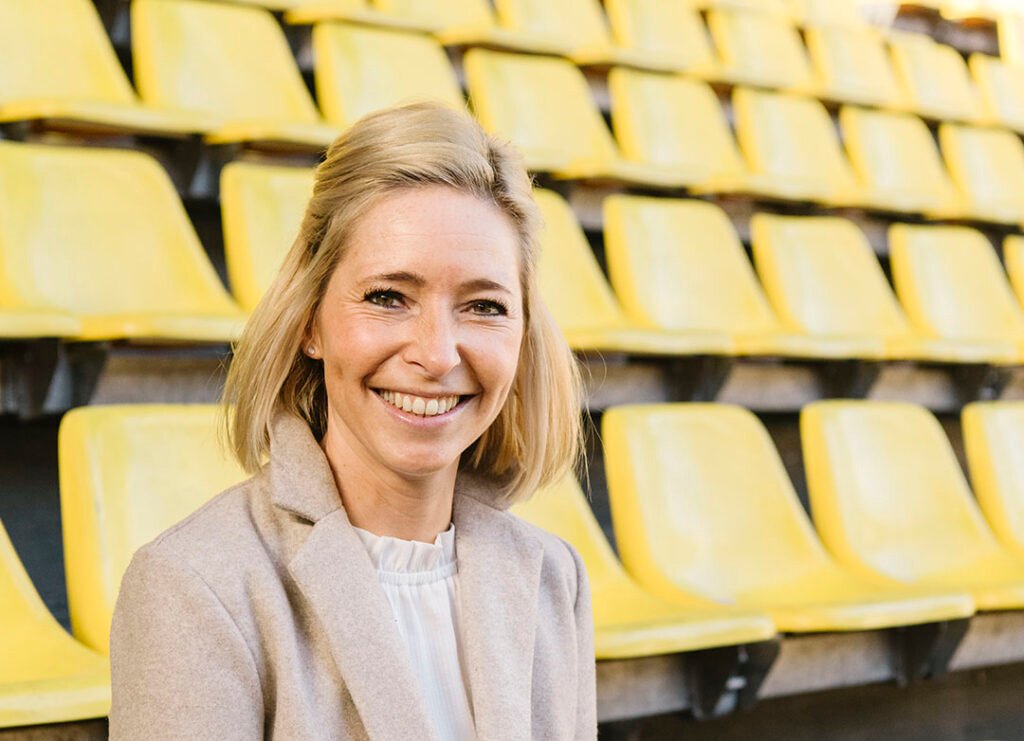
“At the time, our priorities were elsewhere,“ says Svenja Schlenker, head of the Women’s and Girls’ Department at Borussia Dortmund.
The necessary resources simply weren’t there, so the club opted for a later start, and a grassroots one at that. You could compare Dortmund’s approach to building a house. Instead of placing a prefabricated structure on level ground, they first had to lay the groundwork, brick by brick, season by season. Every layer was added with care and intention, forming a solid foundation for everything that followed. Rather than buying a licence from a second-division club or merging with an existing women’s team, BVB chose the long road: starting from the seventh tier and climbing their way up. The decision was put to a vote where 89% of 20,000 participating members supported ‘the journey from the very bottom.’
“In hindsight, that was absolutely the right decision,” Schlenker tells Her Goal. “It gave us the chance to build a solid foundation, grow our staff, and develop our teams properly.”
Despite some early criticism and calls for a faster approach, she says she would ‘make the same choice again, every time.’
“We’ve got two more promotions to go; it won’t be long before we’re up there.”
Building a Department From Scratch
From the beginning, Schlenker has been central to the project. A former midfielder who actually made a cameo for Dortmund (as a striker) during a squad shortage in the pandemic, she led the initial task force and played a key role in the team‘s four consecutive promotions. The success was no accident. With each season, the department grew in professionalism and ambition.
Interestingly, a Munich-based club played a small-but-notable role in the early history of BVB’s women’s team: their very first friendly match in 2020 was against the women’s side of Bayern’s city rivals, TSV 1860 Munich, themselves newly founded that same year.
Today, the Women’s and Girls’ Department includes not only the first and second women’s teams but also a U17 squad, with plans to add a U15 side next season. The program benefits from access to many of the club’s existing resources, from state-of-the-art training facilities like the Footbonaut to shared knowledge across departments. The Footbonaut is a high-tech training system that fires balls at players from all angles inside a grid-like arena, helping them improve reaction speed, ball control, and passing accuracy under pressure.
Additionally, some of the young female talents train alongside boys in youth setups, which marks a significant step in player development. Markus Högner, who has coached the first team since the beginning of this season, describes the synergies between the men‘s first team, the youth performance centre and the women‘s department as a major asset to the club-wide project.
The next milestone is already in the works, with a dedicated training facility exclusively for women and girls. And perhaps even more significant – first-team players now hold a professional contract, which remains a rarity at this level.
“Our goal is to be a pioneer in women’s football,” Schlenker emphasises. “But with sustainability at the core.”
“We were clear from the beginning: this project isn’t about marketing. We’re building something real and lasting.”
High Ambitions, Rapid Growth
Rapid success brings rapid change. With each promotion, the club has had to integrate waves of new players – a challenge when trying to build a cohesive unit capable of performing from day one. But the club’s ambitions are clear: promotion to the Bundesliga as soon as possible, and from there, a push towards the top of the table, and eventually, Champions League qualificatio
That means fierce competition, not just nationwide, but regionally, in a densely-packed footballing landscape in west Germany featuring the likes of Leverkusen, Cologne, Schalke, and Essen. Yet the BVB badge carries weight. That was evident from day one, when the team began in the seventh division and immediately drew players eager to pull on the black-and-yellow shirt.
This past summer saw the biggest transformation yet, with 16 new signings, including players with top-flight experience. For those in charge, the priority was clear in recruiting players who could not only compete immediately but also form the backbone of the team through future promotions and tougher challenges ahead.
The most high-profile addition? Aforementioned head coach Markus Högner, who joined after 12 years with SGS Essen.
“I was looking for a new challenge,” he explains. “And this opportunity at Borussia Dortmund, a club of this magnitude, with a clear vision to get to the Frauen-Bundesliga, was exactly what I wanted.”
“What really convinced me was how serious the leadership is about developing women’s football here.”
It is a sentiment echoed by the players.
“What sets us apart is our team spirit and trust in one another,” says captain Paula Reimann.
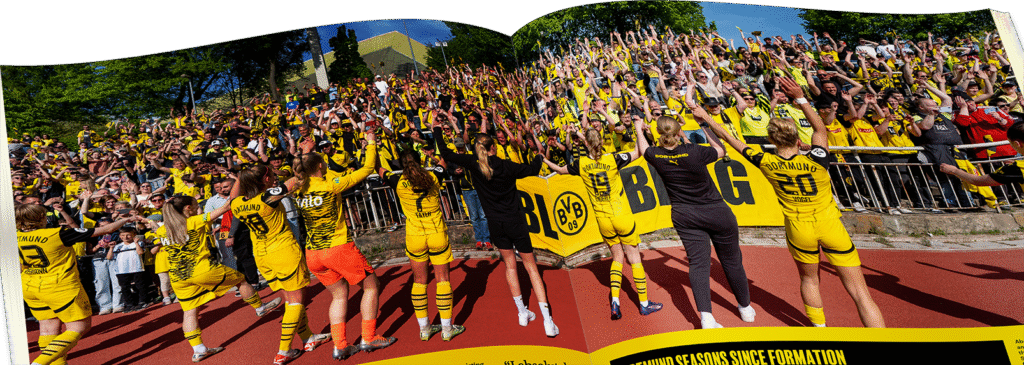
She is well aware of the high expectations placed on her and the squad but says that the pressure does not hold her back. The 23-year-old joined in the summer of 2024 and has experienced some of the club’s biggest moments, including the derby win over Schalke, played in front of a record 10,000 fans at Stadion Rote Erde. That match proved pivotal in securing last season’s promotion and offered a glimpse of what this team is capable of, both on and off the pitch.
History Made Against Bayern
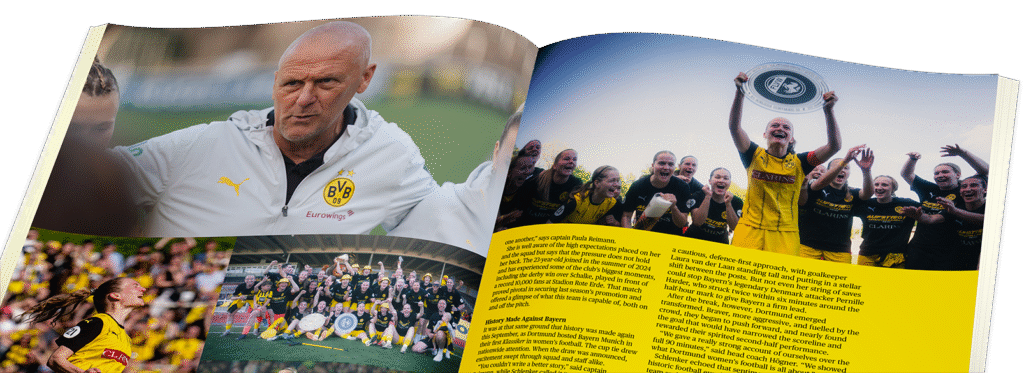
It was at that same ground that history was made again this September, as Dortmund hosted Bayern Munich in their first Klassiker in women’s football. The cup tie drew nationwide attention. When the draw was announced, excitement swept through squad and staff alike.
“You couldn’t write a better story,” said captain Reimann, while Schlenker called it ‘totally surreal’ that, just a few years after founding the department, they would play the reigning double winners.
Högner spoke of ‘a different dimension,’ praising the occasion as the highest-profile moment in the team’s young history. There were even discussions about moving the game to the big stadium, but scheduling conflicts with the men’s team, along with the desire to preserve home advantage at Stadion Rote Erde, kept the fixture at its spiritual home; the ground where they have already celebrated several key milestones.
It proved to be the right call. On a rainy Monday night, an electrifying crowd of 15,755 turned the intimate ground into a roaring black-and-yellow fortress. Even Bayern’s players took notice.
“You have to give Dortmund a lot of credit, they made it really tough for us in the second half,” Giulia Gwinn, Bayern defender and Germany captain, told FC Bayern TV. “It was a fantastic setting.”
And it wasn’t just the noise in the stands that impressed – the BVB players delivered a performance that commanded respect. In the first half, the hosts adopted a cautious, defence-first approach, with goalkeeper Laura van der Laan standing tall and putting in a stellar shift between the posts. But not even her string of saves could stop Bayern’s legendary Denmark attacker Pernille Harder, who struck twice within six minutes around the half-hour mark to give Bayern a firm lead.
After the break, however, Dortmund emerged transformed. Braver, more aggressive, and fuelled by the crowd, they began to push forward, and nearly found the goal that would have narrowed the scoreline and rewarded their spirited second-half performance.
“We gave a really strong account of ourselves over the full 90 minutes,” said head coach Högner. “We showed what Dortmund women’s football is all about.”
Schlenker echoed that sentiment: “It was a beautiful, historic football evening. I’m incredibly proud of the team and the coaching staff.”
A Taste of What’s to Come
Despite being knocked out of the DFB-Pokal by Bayern, Dortmund’s players walked off the pitch with their heads held high. This wasn’t a setback – it was a glimpse into the future. A preview of the kind of high-profile matches that the club aims to play, and the level of media attention it expects to attract.
Over time, BVB has steadily built public interest, driven in no small part by the team’s continued success on the pitch. The club is now firmly on the radar of both the DFB (Germany’s federation) and UEFA, and has already been invited to participate in strategic working groups. This indicates a clear signal that Dortmund is being viewed as a serious future contender.
Because if all goes to plan, they expect to reach the Frauen-Bundesliga by 2027. And five years from now?
“I absolutely see us in the top flight, competing in the top third of the table,” states Schlenker. “After that, the next target is the Champions League.”
And ideally, those future European nights will be played at none other than Signal Iduna Park, Germany’s largest stadium, with a capacity of over 81,000. It’s an ambitious vision, but one that fits a club like Borussia Dortmund. A club with history, with drive, and now, with a women’s team ready to earn its place at the very top.
This article was published in Her Goal Magazine [formerly She Kicks], issue 1.